How do I use a Japanese ticket vending machine?
Money goes in first. The buttons are dead until the machine has your cash, which is the moment almost every visitor decides something is broken. Once it is lit, the grid reads top-left to bottom-right in order of popularity, the extras are the small buttons underneath, and your change comes out of a lever at the very bottom.
The ritual, in order
The same six moves at every machine in the country
Find it before you look for a seat
It is inside the door, usually on the left, and it is lit. At a ramen or soba shop the queue forms at the machine rather than at the counter; at a museum it stands beside the entrance and the staffed desk is for people who need help with it.
Put the money in first
This is the whole trick. The buttons stay dark until the machine has your cash and nothing is broken. Coins go in the round slot, notes in the thin slot on the right. A ¥1,000 note always works. A ¥10,000 note often does not.
Press the main item, then the extras
The house standard is the cheapest item of its kind on the machine — the thing the place exists to sell, and the safe choice every time. It is often the top-left button, but that is a habit rather than a rule and newer machines break it. Extras and sides are the smaller buttons in the lower rows, and drinks are usually the bottom row in a different colour.
Check what came out
Some machines print one ticket per press; some print a single combined slip. If you pressed twice by accident you will be holding two tickets, and the counter will honour both. Hand back the extra at once rather than after the food arrives.
Take your change from the bottom
The change lever or tray is at the bottom of the machine, well below the ticket slot, and it is the most-forgotten part of the sequence. Some machines need the lever pushed; newer ones drop the coins on their own.
Hand the ticket over face up
Put it on the counter rather than into a hand, and wait to be pointed at a seat if the place is full. At a museum you feed it to the gate or hand it to the attendant, who tears it and gives you the stub.
What they will say to you
Four sentences you might hear at a machine
Most of the time nobody speaks to you at all. These are the four things staff say when something needs sorting out, and each takes a one-word answer.
| You’ll hear | It means | Say |
|---|---|---|
| 食券はお持ちですか?Shokken wa o-mochi desu ka? | Do you have a meal ticket? | はいHai — yes |
| 券売機はあちらです。Kenbaiki wa achira desu. | The ticket machine is over there. | ありがとうございますArigatō gozaimasu — thank you |
| 先に食券を買ってください。Saki ni shokken o katte kudasai. | Please buy a ticket first. | わかりましたWakarimashita — understood |
| 売り切れです。Urikire desu. | That one is sold out. | わかりましたWakarimashita — understood |
The grammar of the grid
Reading a machine you cannot read
The layout is not a menu and it is not organised by category. It is organised by what the shop wants pressed, reading top-left to bottom-right, because that is where a Japanese reader's eye lands first — the machine makers say as much in their own sales material. For a long time that meant the house standard sat top-left, and at a soba stand on a platform or an old kissaten it usually still does.
Where it breaks is the newer machine. A shop that knows where your eye lands can put its most expensive version there instead, in the largest button, and leave the plain one small and low. So treat top-left as a hint and not an answer. What still works is price: the house standard is the cheapest item of its kind on the machine, and you can find it without reading anything.
The second row is usually the same item with something added — an egg, extra pork, extra noodles, a larger size. The lower rows are sides, rice and drinks, often in a different colour. A button that is dark is either sold out or waiting for your money, and there is no way to tell which until you have paid. If it stays dark after your cash is in, it is sold out: press something else.
Newer machines have a touchscreen with an English toggle in a corner of the screen — look at the corners, not the middle — and many now take Suica and Pasmo, tapped flat on a pad rather than pushed into a slot. Older button machines take coins and ¥1,000 notes only, and those are frequently the shops worth queueing for.
Don't start pressing buttons before the money is in. They are dead until the machine has your cash, and nothing on the machine tells you that.
Where else this happens
One skill, four counters
The machine is the same object wherever you meet it, which is why it is worth learning once. At a ramen counter it is the whole ordering system and there is nothing to pay at the end — the two questions the cook then asks you are on the ramen shop page. At a soba or udon stand in a station it works identically, at speed, with a queue behind you. In older cafés and some kissaten you buy a coffee ticket at the door and hand it over at the counter, which is covered on the coffee shop page. At a museum or a public bath it prints an admission ticket you feed to a gate.
A food ticket machine is not a train ticket machine, and confusing them costs you time in the wrong queue. The food machine sells one thing at a fixed price with no destination, no fare chart above it, and no gate behind it. The train machine has a fare map on the wall above it, asks you for a number of passengers, and sells a ticket that a gate will eat — that one has its own sequence on the train ticket machine page.
Carry more cash than feels reasonable. Card acceptance is far better than it was, but ticket machines, small counters and IC-card top-ups are still routinely cash-only, and the reliable foreign-card ATMs are in convenience stores.
Questions
The things people ask standing in front of one
Why are all the buttons dark?
Because the machine has no money in it yet. Feed a coin or a ¥1,000 note in and the buttons light up within a second. This is the single most common moment of panic on this site, and nothing is broken.
Will it take a ¥10,000 note?
Often not, and older machines usually will not. A ¥1,000 note always works, everywhere, and is what to carry. Break the big note in a convenience store on the way — the ATMs there are open 24 hours and take foreign cards.
Can I use Suica, Pasmo or a credit card?
Newer touchscreen machines take Suica and Pasmo — the card lies flat on a pad, it does not go in a slot — and a few take credit cards. Older button machines take coins and ¥1,000 notes only. Assume cash until you can see a card reader on the front.
Where is my change?
At the bottom of the machine, in a tray or behind a small lever marked おつり, well below where the ticket came out. Some machines need the lever pushed. If a ¥1,000 note bought a ¥900 bowl, that ¥100 coin is sitting down there.
Which button do I press if I can't read anything?
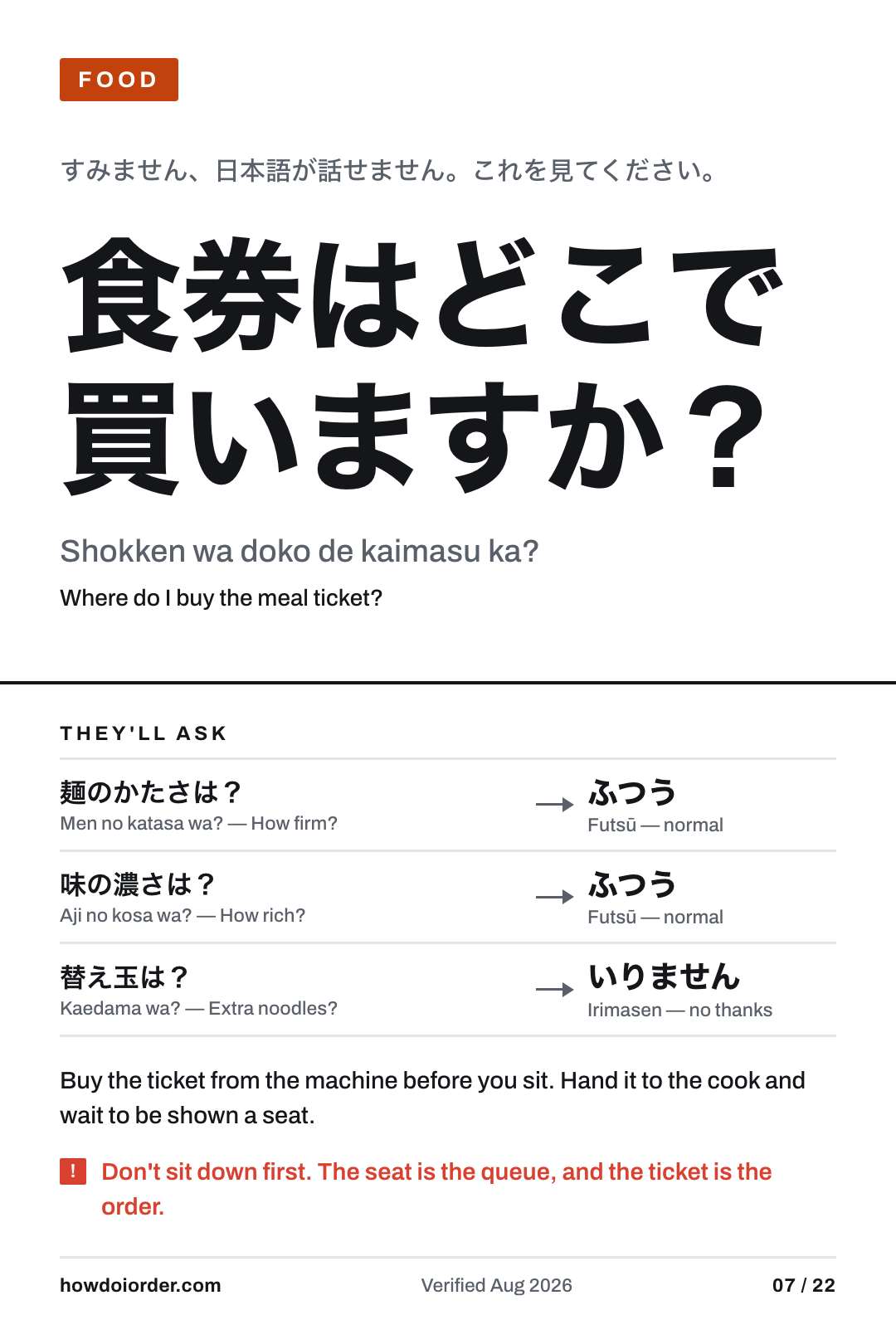
Top-left. The grid runs from most-ordered to least, so the top-left button is the house standard and is a safe order every time — usually ¥800 to ¥1,200 at a ramen counter. Holding up the card at the top of this page also gets people pointing at the right button.
Is this the same machine as at a train station?
No. A train machine has a fare map on the wall above it, asks how many passengers, and prints a ticket a gate will swallow — a short city hop is ¥150 to ¥300 and the fare is read off that map. A food machine prints a slip you hand to a cook. If there is a fare map above it you are at the wrong machine — see the train ticket machine page.
What do I do with the ticket once I have it?
Put it face up on the counter and wait. Do not sit down until you are shown a seat, which at a busy ramen counter can take 5 to 10 minutes and is the one rule worth keeping — onegai shimasu as you set it down is all you need to say. The full sequence is on the ramen shop page. Museums take the ticket at a gate instead.
What if the button I want stays dark after I have paid?
It is sold out — urikire, 売り切れ. Popular items go by 1pm in small shops. Press something else in the same row, or the next cheapest of the same kind; if you want your money back, the change lever at the bottom returns whatever you put in.