How do I order coffee in Japan, and what is the question at the counter?
At a chain you order and pay at the counter, and the one question that decides everything is tennai — for here — or mochikaeri — to take away. Get it wrong and you get a paper cup you did not want. At an old kissaten you are seated and served, takeaway often does not exist, and a morning set is close to free.
The ritual, in order
Which kind of place you have walked into, and what happens next
Check whether anyone seats you
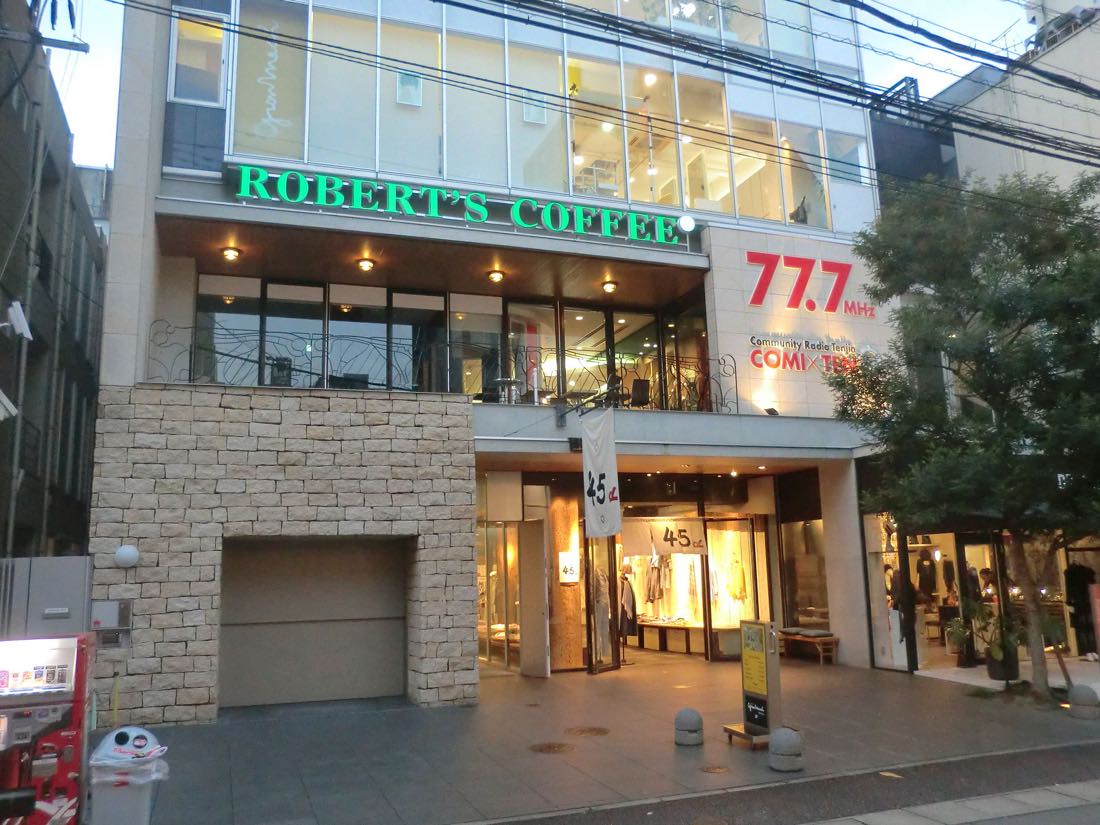
A queue at a till, a menu board above it and a pickup counter means a chain — Doutor, Tully's, Starbucks, Komeda, Excelsior. Dark wood, a handful of tables and someone bringing a menu to you means a kissaten, and the whole order runs the other way round.
At a chain: answer here-or-away first
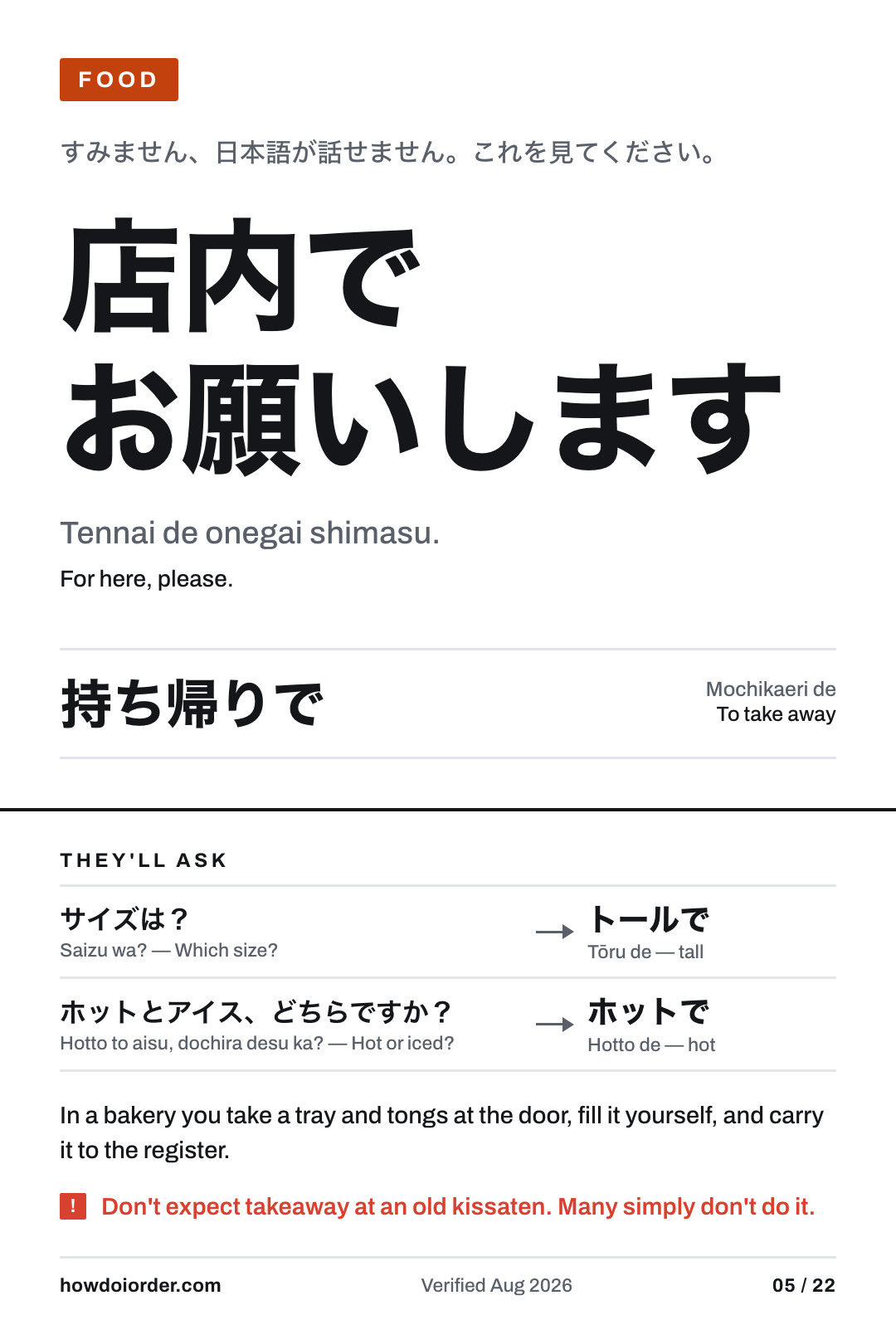
Before size, before hot or iced, staff will ask tennai de o-meshiagari desu ka? — eating in? Tennai de gets you a mug or a glass; mochikaeri de gets you a paper cup and a lid. This also sets the tax rate, which is why they always ask.
Then size, then hot or iced
Sizes are the English words in katakana — shōto, tōru, gurande at Starbucks, S/M/L at most others. Hotto is hot and aisu is iced, and iced coffee is available all winter. A small hot coffee is about ¥300–¥400 at a chain.
Pay at the counter, then wait to be called
You pay before you get the drink. IC cards, QR apps and credit cards all work at the big chains. Take the receipt or the number, stand to the side, and collect from the pickup point — nobody brings it to your table at a chain.
At a kissaten: sit down and wait
You take a table, water and a wet towel arrive, and you order from the table. Coffee is ¥450–¥700 and comes with no pressure to leave. You pay at the register on the way out, and the slip is usually left face-down on your table.
At a bakery: take a tray and tongs at the door
Bread is self-service. Pick up a tray and a pair of tongs by the entrance, put what you want on the tray yourself, and carry the whole thing to the register — staff bag it there. Touching the bread with your hands is the mistake.
What they will ask you
Four questions at a chain counter, in this order
They come fast, in this sequence, and a one-word answer ends each of them. The first one is the only one that changes what you receive.
| You’ll hear | It means | Say |
|---|---|---|
| 店内でお召し上がりですか?Tennai de o-meshiagari desu ka? | Is it to eat in? | 店内でTennai de — for here |
| サイズは?Saizu wa? | Which size? | トールでTōru de — tall |
| ホットとアイス、どちらですか?Hotto to aisu, dochira desu ka? | Hot or iced? | ホットでHotto de — hot |
| お支払いは?O-shiharai wa? | How are you paying? | カードでKādo de — by card |
The kissaten
The old café that will not give you a paper cup
A kissaten is an independent coffee house, often decades old, usually run by one person. It is not a slower Starbucks — it is a different business. You sit, you are served, the coffee is brewed one cup at a time, and the expectation is that you stay. Many have no takeaway at all: no lids, no paper cups, no system for it. The answer to a takeaway request is a flat no, and it is not unfriendliness.
The thing worth walking in for is the morning set — mōningu — served until about 11:00 and, in Nagoya especially, close to a gift. You order a coffee at its normal price and thick buttered toast, a boiled egg and sometimes a small salad arrive with it at no extra charge or for a hundred yen or two. It is the cheapest good breakfast in Japan.
Two practical warnings. A lot of kissaten are cash only, and the sign saying so is often small and in Japanese. And Japan's indoor smoking rules carry an exemption for small existing premises, so some kissaten still allow smoking — if that matters to you, look through the window before you sit rather than after.
Don't assume you can take a kissaten coffee away. Many have no paper cups and no lids at all, so the answer is a flat no rather than an inconvenience — order it at a chain if you need to walk with it.
Money
Cash, tax and the tray
Carry more cash than feels reasonable. Card acceptance is far better than it was, but ticket machines, small counters and IC-card top-ups are still routinely cash-only, and the reliable foreign-card ATMs are in convenience stores.
Here-or-away is also a tax question. Takeaway food and drink is charged at the reduced 8% consumption tax; anything consumed on the premises is 10%. That is why the question is asked before anything else, and why some menu boards print two prices side by side. It is a few yen, but it is the reason the staff will not let the question go.
Money goes in the small tray, not into the hand. This is the single most common thing visitors get wrong, and it happens at almost every register in the country.
Questions
What people ask before their first coffee
How do I say 'to take away'?
Mochikaeri de — to take away. Tennai de — for here. Both are complete answers on their own and neither needs a sentence around it. Staff will ask tennai de o-meshiagari desu ka? before size or hot-or-iced, so have the answer ready first.
Why are there two prices on the menu board?
Consumption tax. Takeaway is 8%, eat-in is 10%, so a ¥350 coffee is a few yen cheaper in a paper cup. Chains that show both prices are displaying the same drink under the two rates, not two different sizes.
What is a morning set?
Mōningu — a coffee ordered before roughly 11:00 that comes with toast and a boiled egg for little or nothing extra. It is standard at kissaten across the country and near-religious in Nagoya. Expect the whole thing to land at ¥500–¥700, which is about what the coffee costs alone.
Can I work on a laptop in a café?
At a chain, yes — Doutor, Tully's and Starbucks all expect it and many seats have a plug. At a kissaten, read the room: some have a written no and most have no wifi. A two-hour occupation of a four-seat kissaten on a ¥500 coffee is the thing not to do.
Is the coffee cash only?
At a chain, no — IC cards, QR payment and credit cards all work. At a kissaten, often yes, and the sign is small. Carry a ¥1,000 note; the same problem shows up at ticket machines and small counters, which is why the konbini ATM is the reliable place to get cash.
How does the bakery counter work?
Take a tray and tongs from the stack by the door, put the bread on the tray yourself, and carry it to the register — do not touch the bread with your hands. Most items are ¥150–¥300. Staff bag it at the till and will ask about a bag, which is chargeable, usually ¥3–¥5.
Do I bus my own table?
At a chain, yes — there is a return counter with slots for cups, trays and rubbish, usually near the exit. At a kissaten, no: leave the cup and the ¥450–¥700 slip where they are and pay at the register on the way out, the same pattern as paying a restaurant bill.
What about the coffee machines and vending machines?
Convenience-store coffee is ¥120–¥200: you buy a cup at the till, then put it in the machine yourself and press the button. Street vending machines sell hot canned coffee from about ¥130 in winter — the red label under a can means it is hot. Machine buttons work the same way as the ticket machines: money first, then the lit buttons.